

STATEMENT: Fair Finance Asia Network Calls on World Bank Group to Strengthen Climate and Accountability Commitments
Alarming gaps in the World Bank Group’s (WBG) approach to climate action and accountability risk undermining Asia’s energy transition agenda and the rights and shared prosperity of local communities and the environment, which lie at the core of the Bank’s goals.
In its Climate Change Action Plan (CCAP) 2021-2025, WBG committed to aligning all financing operations with the goals of the Paris Agreement. More specifically, any new financing, public or private, will support member countries’ pathways towards low greenhouse gas emissions and climate-resilient development. In June 2026, the Bank drastically changed course, extending the CCAP but walking away from its goal to commit at least 45 percent of its portfolio for climate change projects, raising serious concerns about whether climate action will ever return as a key priority for one of the world’s largest multilateral development banks (MDBs). Meanwhile, through instruments like equity, underwriting, blended-finance vehicles, and technical assistance, WBG continues to indirectly finance Asian countries’ coal dependence by lending to financial intermediaries that fund large coal developers. These loopholes are highlighted in Fair Finance Asia’s (FFA) 2026 report, Phasing out Coal, Phasing in Justice, which reiterates civil society concerns that World Bank’s (WB) own 2013 coal exclusion is limited: it does not extend to general-purpose or corporate financing for coal producers, or lending routed through financial intermediary clients.
In April 2026, WBG and other MDBs issued a joint statement announcing their intention to work together to develop critical minerals to manufacturing value chains for clean energy access. Gaps remain, however, in WBG’s safeguards related to protecting the environment and biodiversity and supporting local value addition for affected communities. While the International Finance Corporation’s (IFC) Performance Standards (PS) imposes enhanced requirements for projects affecting critical habitats and protected areas, it still allows investments to proceed under certain conditions, rather than establishing clear no-go zones for highly sensitive ecological and cultural areas. Moreover, FFA’s 2026 report, Extraction to Equity, found that IFC’s PS only requires financial intermediaries to “engage with” affected communities in critical minerals investments, not to guarantee a direct financial or economic benefit. These gaps are concerning given that Association of Southeast Asian Nations’ (ASEAN) regional minerals strategy explicitly calls on MDBs to provide de-risking capital to mobilize private investment in critical minerals. Core elements of just transition are already missing from critical minerals bilateral trade agreements and Memoranda of Understanding (MoUs) proliferating in resource-rich ASEAN countries. Of the trade agreements that FFA’s report assessed, most make general references to sustainability; they rarely include explicit commitments to implementing international sustainability standards, and none include binding commitments to uphold human rights standards, such as obtaining free, prior, and informed consent (FPIC). Robust MDB safeguards are crucial especially in critical mineral projects that are often linked with serious social and environmental harms, including air pollution, water contamination, and corresponding public health impacts.
In June 2025, WBG dropped its long-standing ban on financing for nuclear energy projects. Nuclear energy is associated with many risks, such as nuclear proliferation, waste management, safety issues, water consumption, vulnerability to natural disasters and military attacks, and astronomically high costs. Despite these concerns, the Asian Development Bank (ADB) followed suit by lifting its ban on nuclear financing, highlighting the risk that WBG’s backtracking on key commitments has a cascading effect among other MDBs.
Additional concerns about the WBG’s commitment to upholding the rights and well-being of local communities surfaced in June 2026 when the Board of IFC rejected the findings of its own Compliance Advisor Ombudsman (CAO), which highlighted debt and land dispossession harms linked with IFC’s intermediary lending to microfinance institutions in Cambodia. Amidst the WBG’s accountability merger, this case raises questions as to whether the independence and authority of the Bank’s accountability mechanisms will remain sufficiently protected and can provide effective redress for communities.
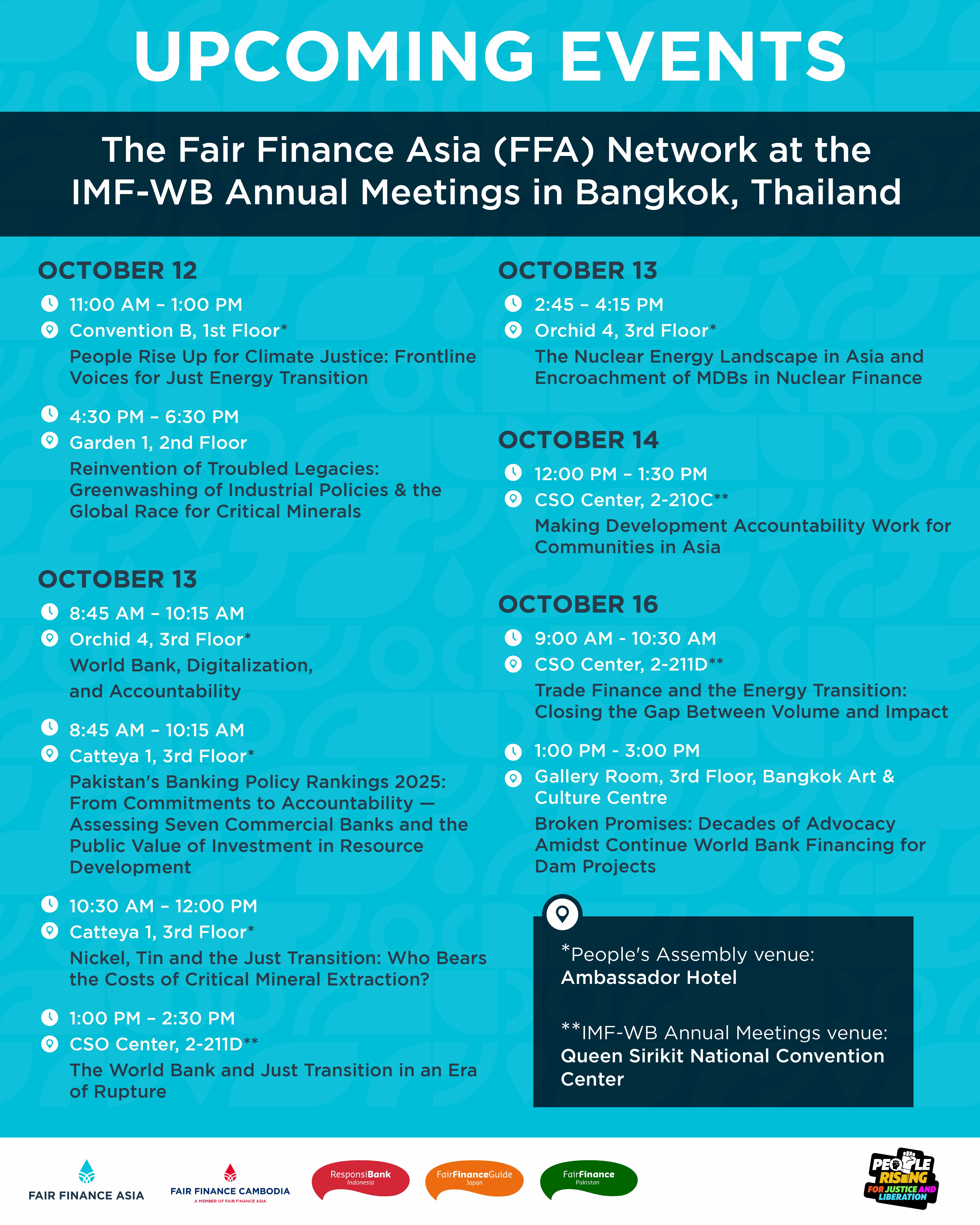
The 2026 Annual Meetings of the International Monetary Fund (IMF) and World Bank (WB) in Bangkok, Thailand, present a vital opportunity for WBG to better understand concerns being raised by affected communities and civil society experts and strengthen its approach to climate action and accountability. To this end, the FFA network raises the following calls to action.
- Strengthen climate commitments by increasing, not diluting, climate ambition and closing loopholes in coal financing through intermediary lending and ending investments in fossil gas, such as Liquefied Natural Gas (LNG), and other false solutions. This means no coal or gas expansion to serve rising Artificial Intelligence (AI) or data-center demand. WBG should match financed data centers and AI infrastructure with additional renewable capacity, grid investment, disclosure of their energy footprint and any climate finance claimed at sub-component level, while embedding rights-based safeguards aligned with international standards like United Nations Guiding Principles on Business and Human Rights (UNGPs).
- Advance equitable governance, benefit-sharing, and stronger social and environmental safeguards in critical minerals investments. IFC’s PS must ensure that communities are guaranteed direct financial or economic benefit and have full and timely access to critical information, such as contracts and licenses, public country-by-country financial reporting, project-level payments to governments, and beneficial ownership disclosure. WBG should also strengthen and uphold social and environmental safeguards in critical minerals projects financed by the Bank and financial intermediaries, in support of building member countries’ capacity to: endorse and implement the UN Principles to Guide Critical Energy Transition Minerals Towards Equity and Justice; strengthen due diligence, including mandatory environmental and human rights due diligence (EHRDD) and FPIC of Indigenous Peoples and local communities; make environmental and social impact assessments mandatory for mining permits and expansion projects; adopt robust fiscal, benefit-sharing, and local value addition policies to ensure critical minerals contribute to national development; improve transparency and accountability through the Extractives Industry Transparency Initiative (EITI) implementation, mandatory public reporting, and disclosure requirements; and develop sustainable finance taxonomies aligned with international human rights, labor, and environmental standards. Under no circumstances should WBG investments proceed into no-go zones.
- Make EHRDD a condition of financing in air-polluting mining and energy projects by requiring site-specific baselines, cumulative-impact assessment (CIA), independently reviewed tailings and water-risk plans, and measurable pollution controls. Translate findings into enforceable covenants, corrective-action deadlines and provisions to suspend disbursement when agreed conditions are breached. Enhanced due diligence is especially critical in Asian countries where multiple mining developments are often concentrated in specific geographical areas, and incremental impacts arise from existing or planned mining operations. In such cases, risks to the environment and local communities are even higher; a CIA may be needed to identify the complex interactions of risks and impacts. This approach aligns with IFC’s PS 1.
- Keep nuclear power out of climate finance. WBG and other MDBs must not brand or count nuclear energy, including small modular reactors (SMRs), as a climate solution in their energy policies or climate finance frameworks. SMRs are an unproven and highly expensive alternative. Despite the marketing around lower costs and faster deployment, no SMR is yet operating commercially in the region; the technology carries the same long lead times, financing uncertainty, and proliferation and waste concerns as conventional reactors, now dressed up as “innovation.”
- Strengthen accountability in financial intermediary investments by requiring stronger due diligence, monitoring, reporting, feedback and grievance mechanisms for banks, microfinance institutions, and other intermediaries receiving IFC financing. WBG must also protect and strengthen the independence of accountability mechanisms by ensuring that any reforms or institutional changes preserve the full operational independence of investigators and complaint-handling bodies free from retaliation. When accountability mechanisms identify harm or non-compliance, affected communities should have a clear pathway to remedy; where findings are not accepted, the Board should publicly explain reasons for rejection and how affected communities will still receive remedy. The Bank must also ensure meaningful participation of affected communities throughout investigations, remedy design, implementation, and monitoring. Nothing about affected communities without affected communities!
This statement is endorsed by:
- Fair Finance Asia’s Regional Team
- Fair Finance Bangladesh
- Fair Finance Cambodia
- ResponsiBank Indonesia
- Fair Finance Guide Japan
- Fair Finance Pakistan
- Fair Finance Philippines
- Oxfam Pilipinas
- Fair Finance Thailand