

Fair Finance Asia Launches New Report Calling for Stronger Equitable Governance and Benefit Sharing in Asia’s Critical Minerals Financing and Trade
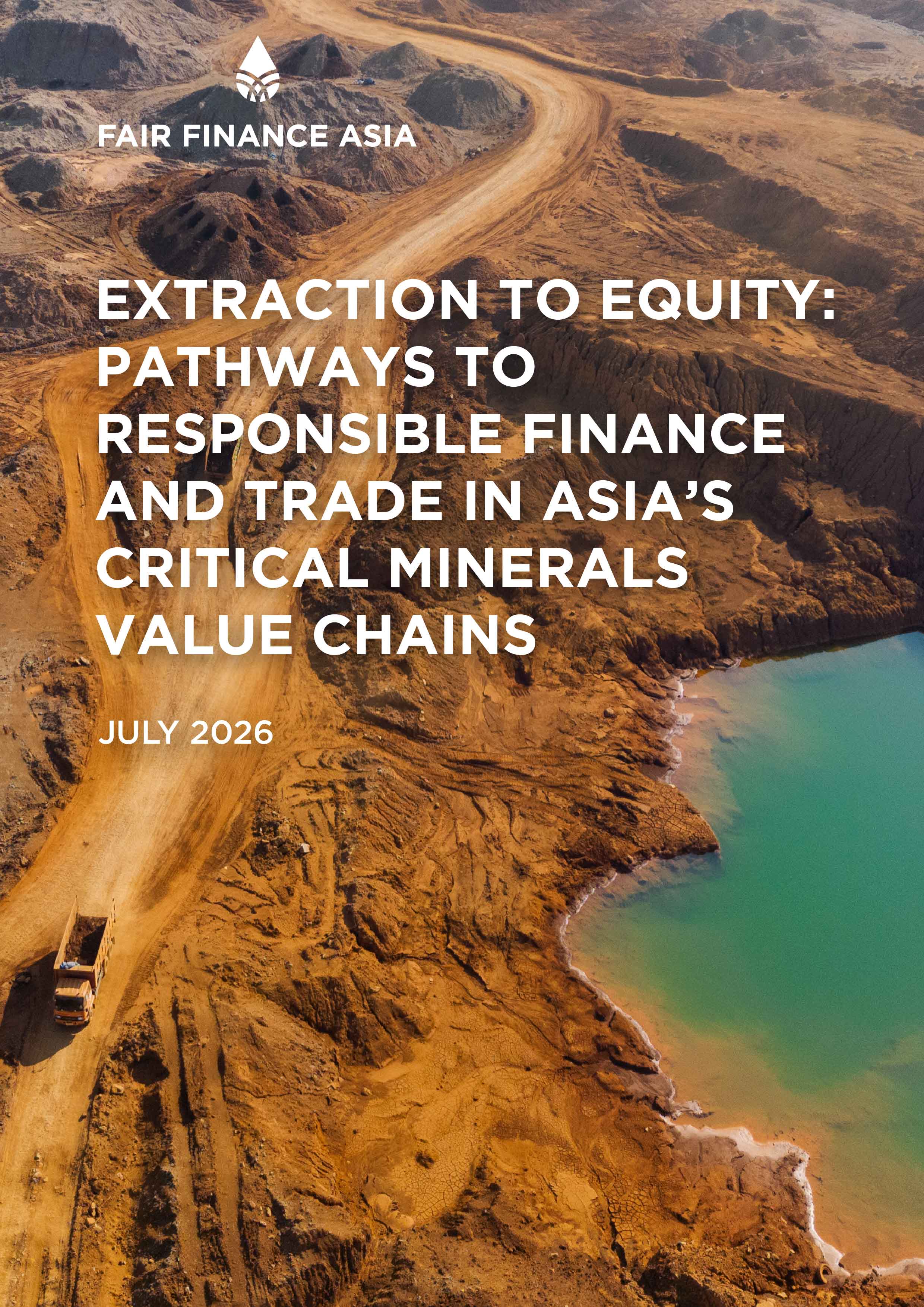
Fair Finance Asia (FFA) and research partner, Profundo, have launched a new report, Extraction to Equity: Pathways to Responsible Finance and Trade in Asia’s Critical Minerals Value Chains, examining the growing importance of critical minerals finance and trade in the Association of Southeast Asian Nations (ASEAN) and the opportunities and challenges they present for a just energy transition. As demand for minerals essential to electric vehicles (EVs), renewable energy technologies, defense, and advanced manufacturing continues to rise, the report explores how resource-rich ASEAN countries can capture greater domestic benefits while addressing governance, human rights, and environmental challenges. This report was developed in collaboration with Fair Finance Cambodia (FFC), ResponsiBank Indonesia, Fair Finance Guide Japan (FFGJ), Fair Finance Philippines (FFPh), and Fair Finance Thailand (FFT).
The report focuses on five resource-rich ASEAN member states—Cambodia, Indonesia, Myanmar, the Philippines, and Thailand—and examines eight minerals essential to the EV value chain: bauxite/alumina, cobalt, copper, graphite, lithium, manganese, nickel, and rare earth elements (REEs). It also explores whether trade agreements and bilateral partnerships are currently effective tools to support the integration of ESG standards that lead to more equitable outcomes for resource-rich countries in critical minerals. These trades agreements and partnerships are assessed against four sustainability criteria 1) the presence of local benefits clauses, 2) provisions prioritizing domestic needs, 3) references to international sustainability standards, and 4) mechanisms for fair pricing aimed at ensuring equitable value sharing between extractive companies, resource-rich countries, and downstream users.
The report finds that ASEAN has established itself as a strategic hub for minerals essential to the global energy transition. Indonesia dominates global nickel production and is the world’s second-largest cobalt producer, while the Philippines is another major nickel producer. Myanmar accounted for 14.8% of global REE production in 2023, Thailand has recently emerged as a potential major player following the discovery of 14.8 million tons of lithium, and Cambodia reportedly holds reserves of bauxite, copper, and manganese.
Across the region, and in line with the ASEAN Minerals Development Vision (AMDV), countries are pursuing downstreaming policies to capture more economic value from critical minerals by shifting from raw material exports to domestic processing and manufacturing. At the same time, geopolitical competition has intensified, with China remaining ASEAN’s primary trading partner and investor, while the United States and the European Union are expanding partnerships to strengthen critical mineral supply chains.
Despite this rapid growth, the report underscores that the ASEAN region faces considerable governance and sustainability challenges that threaten the “green” narrative of the energy transition. Unregulated REE mining in northern Myanmar has resulted in severe soil and water pollution and has been linked to armed conflict, while Indonesia’s expanding nickel industry continues to rely heavily on captive coal-fired power plants, creating a significant carbon paradox.
Between 2011 and 2025, the Transition Mineral Tracker developed by the Business and Human Rights Resource Centre (BHRRC) identified over 50 allegations in Indonesia and the Philippines affecting workers, local communities, Indigenous Peoples, and human rights defenders. FFA’s new report highlights other rights impacts, such as land dispossession, ecosystem degradation, water contamination, deforestation, biodiversity loss, and limited local economic benefits, while noting that shifting battery technologies, geopolitical tensions, and political instability continue to pose risks to regional supply chains.
Furthermore, the report reveals that core elements of a just transition are consistently missing from critical minerals trade agreements and Memoranda of Understanding (MoUs). While many agreements promote local jobs and skills transfer, few include binding provisions on local value content, fair pricing, domestic needs, or international human rights standards, including the Free, Prior and Informed Consent (FPIC) of Indigenous Peoples.
To create incentives for an alternative way forward beyond the current extractivist model, the report calls on resource-rich countries, ASEAN member states, and financial regulators to:
- Endorse and implement the UN Principles to Guide Critical Energy Transition Minerals Towards Equity and Justice.
- Strengthen due diligence, including mandatory environmental and human rights due diligence (EHRDD) and the Free, Prior and Informed Consent (FPIC) of Indigenous Peoples and local communities.
- Make environmental and social impact assessments mandatory for mining permits and expansion projects.
- Adopt robust fiscal, benefit-sharing, and local value addition policies to ensure critical minerals contribute to national development.
- Improve transparency and accountability through the Extractives Industry Transparency Initiative (EITI) implementation, mandatory public reporting, and disclosure requirements.
- Develop sustainable finance taxonomies aligned with international human rights, labor, and environmental standards.
Access the full report here.
Access the executive summary here.
More information:
- Read FFA’s 2024 report tracking serious rights violations in Asia’s critical minerals supply chains here.