

Fair Finance Asia Network’s Engagements at the 2026 Annual Meetings of the International Monetary Fund and the World Bank Group
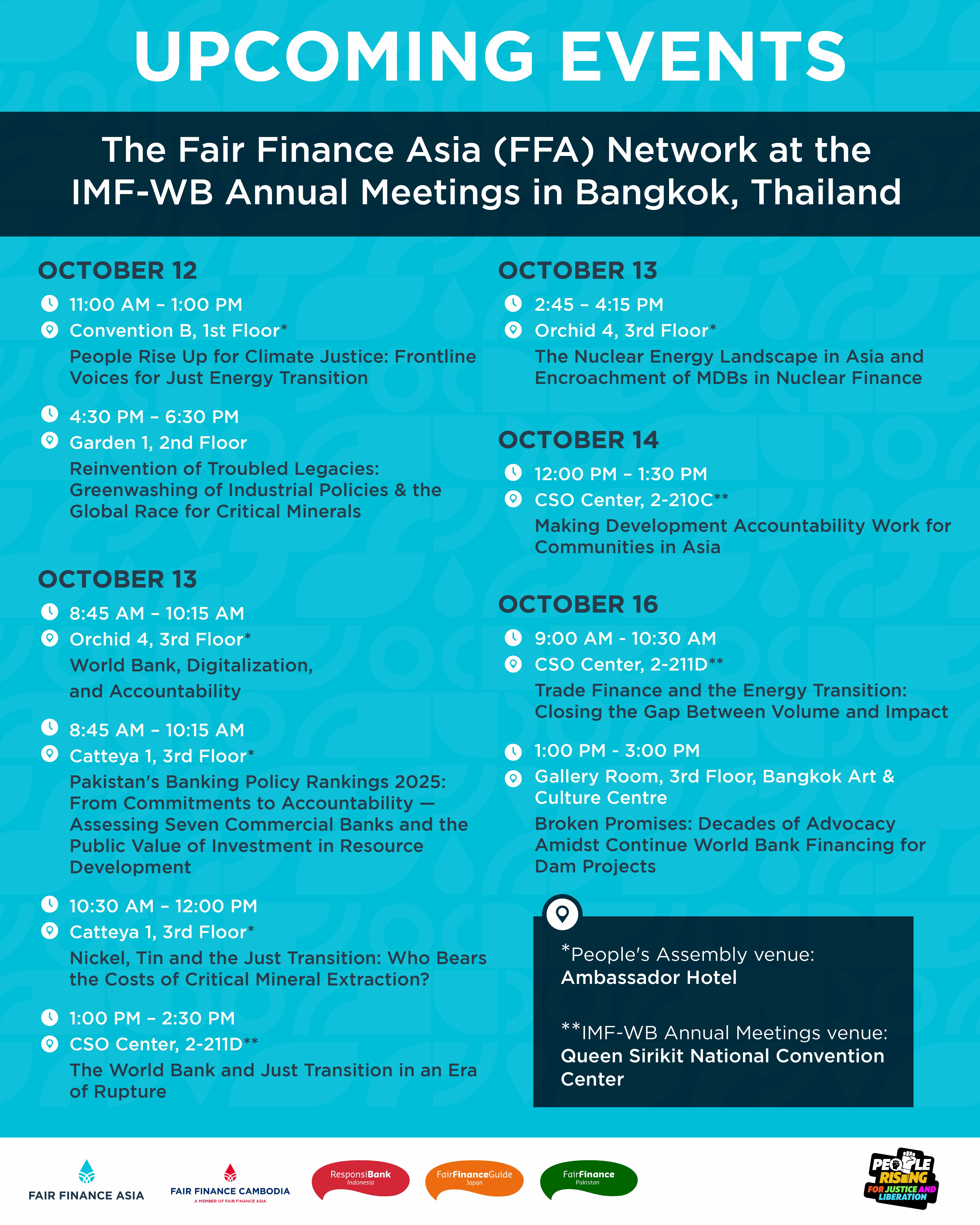
From October 12–18, the Fair Finance Asia (FFA) network will join global, regional, and national civil society, communities, and other allies to co-organize sessions at the Civil Society Policy Forum (CSPF) of the 2026 Annual Meetings of the International Monetary Fund (IMF) and World Bank Group (WBG) in Bangkok, Thailand, as well as the People’s Assembly.
FFA and allies will amplify calls for the World Bank Group (WBG) and other international financial institutions (IFIs) to strengthen climate and just energy transition (JET) commitments; close loopholes in coal financing through intermediary lending; embed equitable governance, benefit-sharing, and other just transition elements in critical minerals investments and trade agreements; ensure effective grievance and redress mechanisms for communities negatively affected by intermediary lending in the microfinance sector; enhance clean air considerations and due diligence in extractives projects; ban the financing of high-risk and high-cost nuclear energy projects.
Learn more about the FFA network’s calls to action for the WBG here.
The 2026 Annual Meetings mark the first return to Bangkok since 1991 and the eighth time they have been held in Asia.
SCHEDULE OF EVENTS (All times are GMT+7)
* People’s Assembly sessions will be held at Ambassador’s Hotel, Bangkok, Thailand.
** CSPF sessions will be held at Queen Sirikit National Convention Center.
October 12 | 11:00 AM–1:00 PM
Convention B, 1st Floor*
People Rise Up for Climate Justice: Frontline Voices for Just Energy Transition
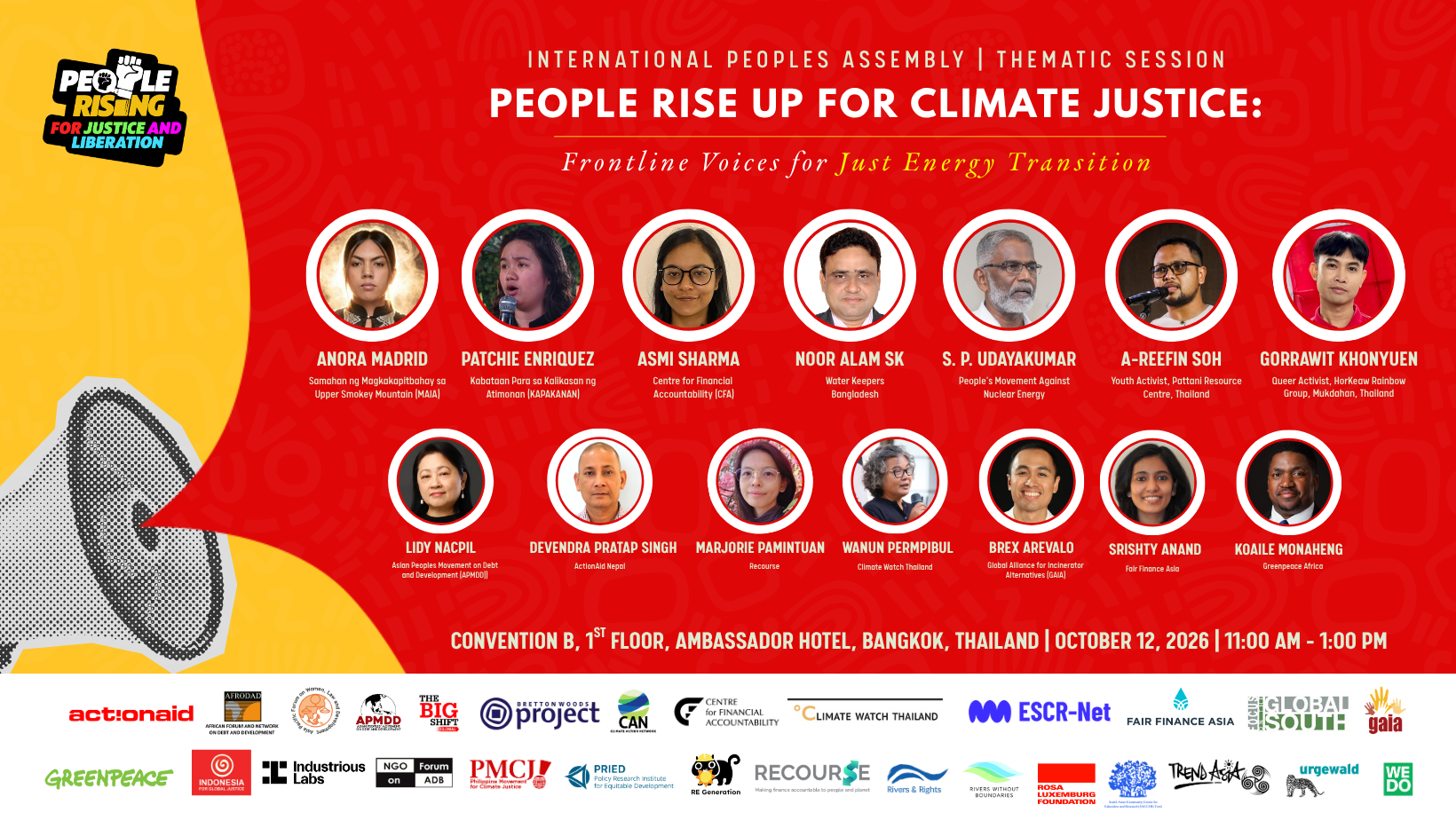
This People’s Assembly thematic session on Climate Justice will bring together civil society, people’s movements, and affected communities to examine climate finance and energy-transition gaps in the Global South and the role of the World Bank and IMF in perpetuating debt, fossil-fuel dependence, and false solutions. It aims to develop common advocacy messages and coordinated action calling for urgent, adequate, and accountable climate finance for a rapid, just, and equitable energy transition that reflects Global South priorities, supports local economies and jobs, and holds MDBs accountable.
Speakers include Anora Madrid (Samahan ng Magkakapitbahay sa Upper Smokey Mountain), Patchie Enriquez (Kabataan Para sa Kalikasan ng Atimonan), Asmi Sharma (Centre for Financial Accountability), Noor Alam SK (Water Keepers), S. P. Udayakumar (People’s Movement Against Nuclear Energy), A-reefin Soh (Pattani Resource Centre, Thailand), Gorrawit Khonyuen (HorKeaw Rainbow Group, Mukdahan, Thailand), Lidy Nacpil (Asian Peoples Movement on Debt and Development), Devendra Pratap Singh (ActionAid Nepal), Marjorie Pamintuan (Recourse), Wanun Permpibul (Climate Watch Thailand), Brex Arevalo (Global Alliance for Incinerator Alternatives), Srishty Anand (Fair Finance Asia), and Koaile Monaheng (Greenpeace Africa).
October 12 |4:30 PM–6:30 PM
Garden 1, 2nd Floor*
Reinvention of Troubled Legacies: Greenwashing of Industrial Policies & the Global Race for Critical Minerals
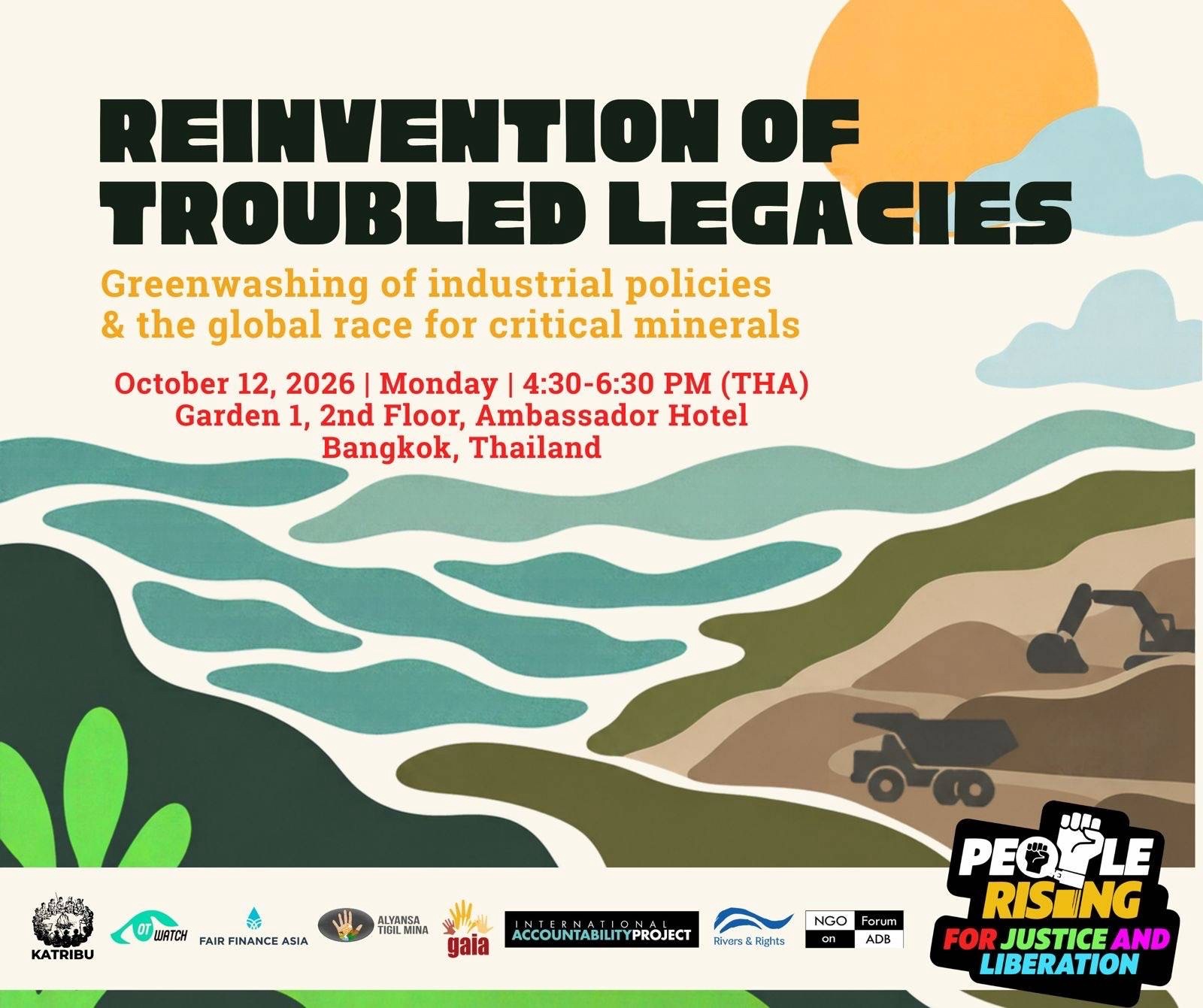
This People’s Assembly thematic session on Extractives will examine how “green industrial policies” and the global race for critical minerals risk reproducing extractive and imperialist legacies, focusing on the role of the World Bank, IMF, and other MDBs in financing and shaping mining and industrial agendas. It aims to connect MDB-backed investments to concrete human rights, community, land, and governance impacts while identifying pathways toward more equitable governance, stronger safeguards, transparency, and benefit-sharing.
Speakers include Nazareth Del Pilar (NGO Forum on ADB), Romchat Wachirarattanakornkul (UN OHCHR Bangkok), Jaybee Garganera (Alyansa Tigil Mina / Asia Pacific Gathering on Human Rights and Extractives), Rahmat Maulana Sidik (Indonesia for Global Justice), Ernest Cornel Oduor (Kenya Human Rights Commission), Funa-Ay Claver (KATRIBU), Bernadette Victorio (Fair Finance Asia), Tanya Lee Roberts Davis (Rivers and Rights), Vaishnavi Varadarajan (International Accountability Project), Lateef Johar (Human Rights Council of Balochistan), Leandro Gomez (Fundación Ambiente y Recursos Naturales), Sukhgerel Degursuren (OT Watch Mongolia), and Mayang Azurin (GAIA Asia Pacific / End E-waste Imports Network).
October 13 | 8:45 AM–10:15 AM
Orchid 4, 3rd Floor*
World Bank, Digitalization, and Accountability
Co-organized by Oxfam in Asia, FFA, Asian Forum on Human Rights and Development (FORUM-ASIA), and Manushya Foundation, this People’s Assembly self-organized session on Digital Rights will examine World Bank-financed digitalization and AI as accountability and human rights issues, rather than simply as technology or development issues. It will explore how digital ID, payment systems, AI, data centers, and other digital infrastructure can create harms—including exclusion, surveillance, data extraction, opacity, due-process violations, lack of remedy, and reduced regulatory space—that existing safeguards and national due-diligence laws may fail to address. The session aims to develop practical questions and demands for what development banks should assess, disclose, and provide in terms of remedy before financing digital systems.
Speakers include Lorenzo Urbinati (Oxfam in Asia), Srishty Anand (Fair Finance Asia), Cornelius Hanung (FORUM Asia), and Emilie Pradichit (Manushya Foundation).
October 13 |8:45 AM–10:15 AM
Catteya 1, 3rd Floor*
Pakistan’s Banking Policy Rankings 2025: From Commitments to Accountability–Assessing Seven Commercial Banks and the Public Value of Investment in Resource Development
Online participation is available here.
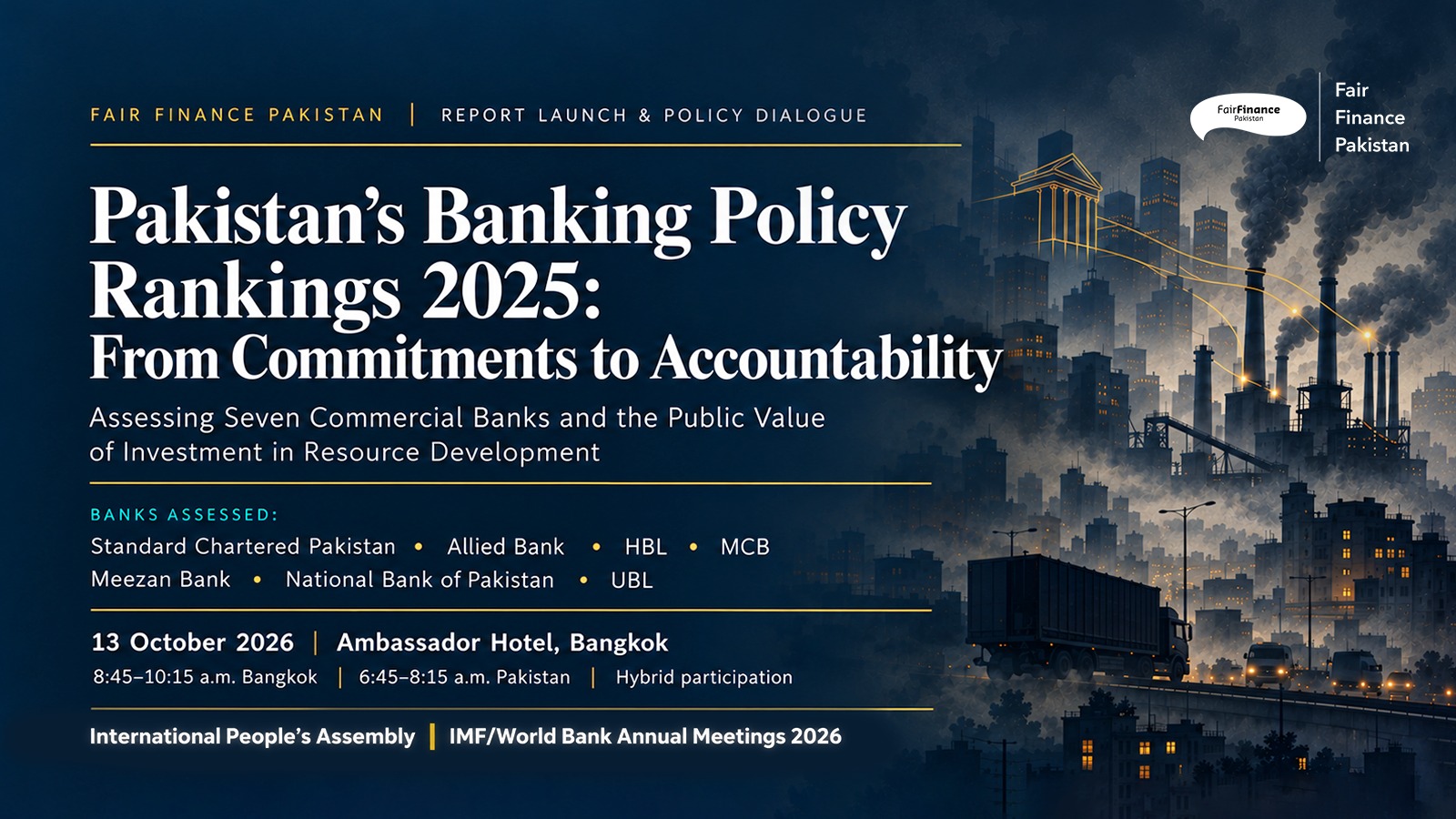
This session launches Pakistan’s 2025 banking sustainability policy rankings and advances a central policy challenge: translating financial institutions’ public commitments into accountable financing decisions. By connecting banking standards with the public value of investment in resource development, the dialogue also examines how lenders can protect rights, reduce pollution and ensure that economic benefits endure without transferring environmental, health and closure liabilities to communities and public budgets.
October 13 |10:30 AM–12:00 PM
Catteya 1, 3rd Floor*
Nickel, Tin and the Just Transition: Who Bears the Costs of Critical Mineral Extraction?
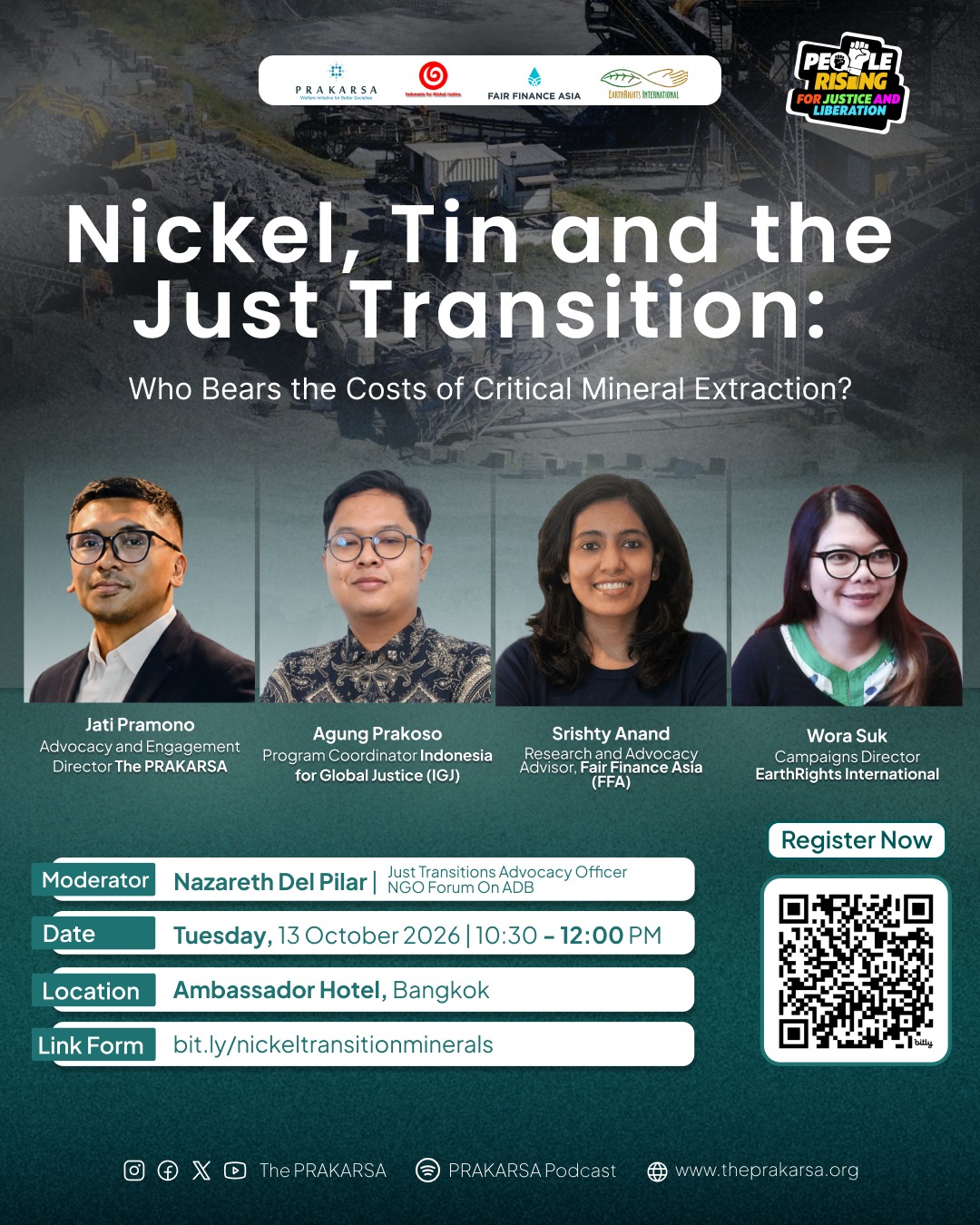
Co-organized by ResponsiBank Indonesia and CSO allies, this People’s Assembly session will examine who benefits from and who bears the human rights, environmental, social, and economic costs of nickel and tin extraction as Southeast Asia expands its role in critical-mineral supply chains. Using Indonesia and the wider Asia-Pacific region as key examples, it will connect mining impacts with Indigenous and community rights, worker concerns, trade and investment policy, corporate accountability, and responsible finance. It aims to identify practical ways to make critical-mineral development more just, including stronger human rights due diligence, meaningful community participation and FPIC, transparency, access to remedy, responsible finance, and fairer benefit-sharing.
Speakers include Jati Pramono (PRAKARSA), Wora Suk (EarthRights International), Agung Prakoso (Indonesia for Global Justice), Srishty Anand (Fair Finance Asia), and Nazareth Del Pilar (NGO Forum on ADB, Moderator).
October 13 |1:00 PM–2:30 PM
CSO Center, 2-211D**
The World Bank and Just Transition in an Era of Rupture
Online participation is available here.
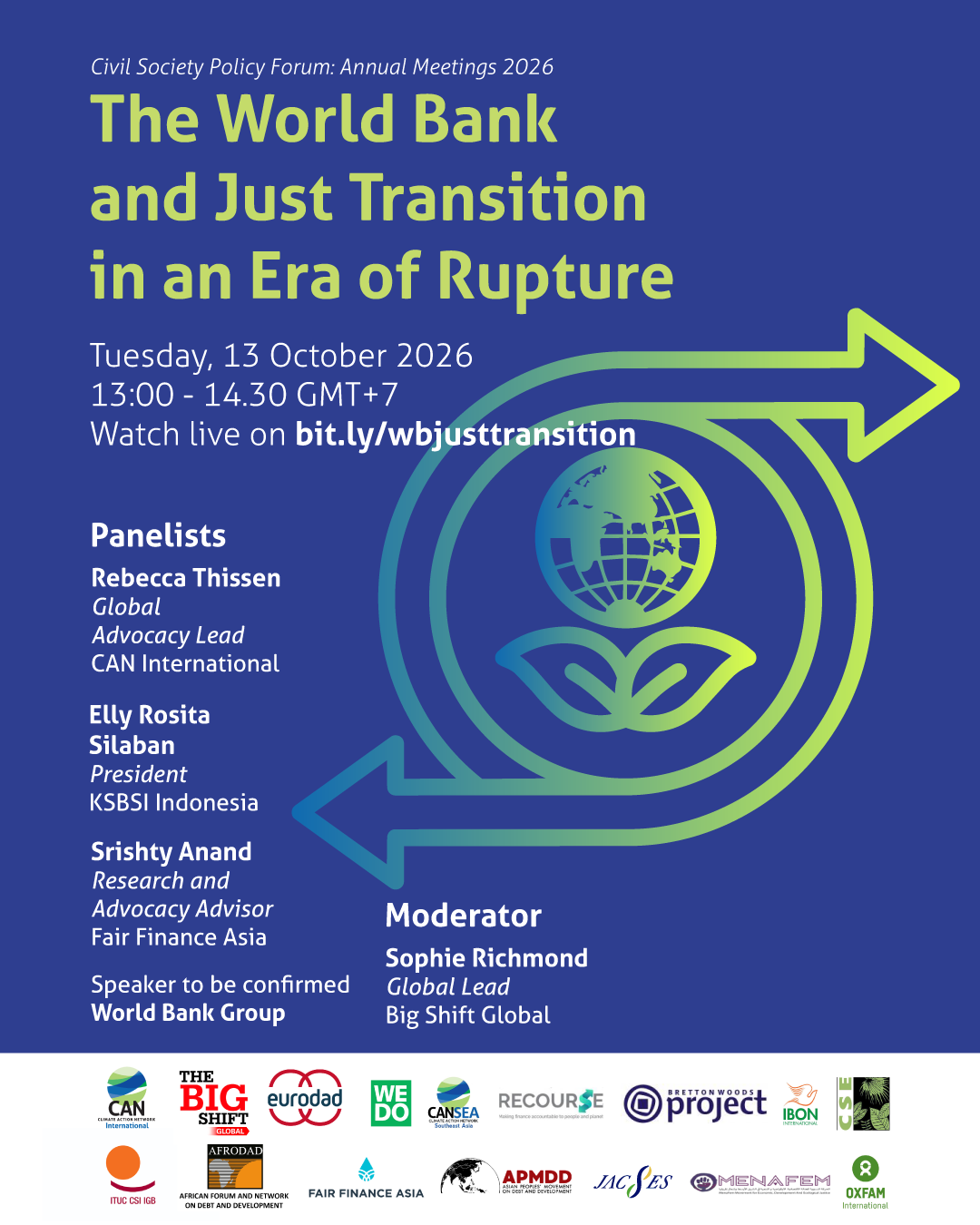
Co-organized by Climate Action Network (CAN) International, Big Shif Global, FFA, KSBSI, and other global, regional, and national CSOs, this CSPF session will examine how the World Bank and other MDBs are financing the Just Transition and whether these flows align with climate justice, worker rights, community protections, and principles emerging from the COP process. It aims to translate the COP30/Belém breakthrough on Just Transition into concrete expectations for MDB financing and accountability, drawing on evidence of coal-financing loopholes, regional energy-transition challenges, and worker rights to develop civil society recommendations ahead of COP31.
Speakers include Sophie Richmond (Big Shift Global, Moderator), Srishty Anand (Fair Finance Asia), Rebecca Thissen (CAN International), and Elly Rosita Silaban (KSBSI Indonesia).
October 13 |2:45 PM–4:15 PM
Orchid 4, 3rd Floor*
The Nuclear Energy Landscape in Asia and Encroachment of MDBs in Nuclear Finance
Co-organized by the NGO Forum on ADB (the forum), Japan Center for a Sustainable Environment and Society (JACSES), and other CSO allies, this People’s Assembly self-organized session on nuclear financing will examine the renewed push for nuclear energy in Asia, including Small Modular Reactors (SMRs), and the growing role of multilateral development banks in financing and legitimizing nuclear projects. It will challenge claims that nuclear is a fast, affordable, safe, and climate-friendly solution, while highlighting concerns around long project timelines, public debt, uranium and waste, proliferation, energy sovereignty, and MDB-driven de-risking. The session aims to build a regional counternarrative and coordinated demands against MDB financing and promotion of nuclear energy, while strengthening collaboration among anti-nuclear movements and affected communities around faster, more democratic renewable alternatives.
Speakers include representatives from Japan Center for a Sustainable Environment and Society (JACSES), Friends of the Earth Japan, South Asian Community Centre for Education and Research (SACCER), NGO Forum on ADB / NFBM, Bangladesh Environmental Lawyers Association (BELA), and Urgewald, with NGO Forum on ADB serving as moderator.
October 14 | 12:00 PM–1:30 PM
CSO Center, 2-210C**
Making Development Accountability Work for Communities in Asia
Online participation is available here.
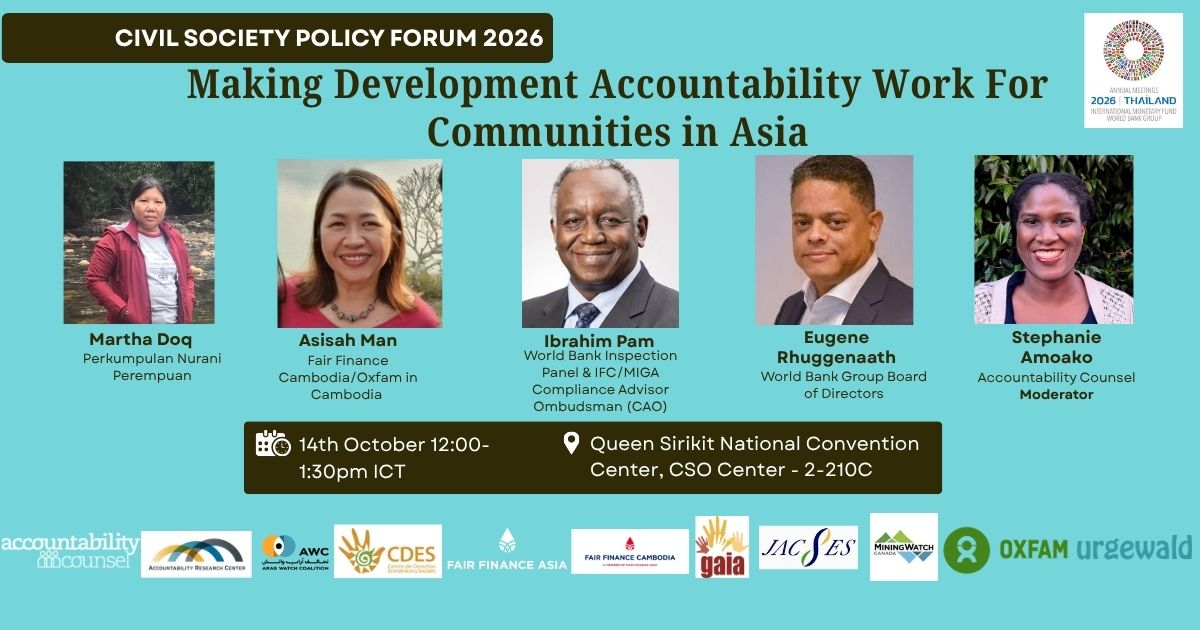
Co-organized by Accountability Counsel, FFA, and other CSO allies, this session will examine whether development accountability mechanisms are delivering meaningful remedy for communities harmed by development finance in Asia, amid growing World Bank and ADB investment and ongoing changes to independent accountability mechanisms. It aims to identify practical ways to strengthen access to accountability and remedy, drawing on regional trends, community experiences, complaint data, and recent cases to address barriers such as eligibility rejections, low complaint volumes, underrepresentation of affected communities, and weak follow-through on accountability recommendations.
Speakers include Stephanie Amoako (Accountability Counsel), Ibrahim Pam (World Bank Inspection Panel / Compliance Advisor Ombudsman), Asisah Man (Fair Finance Cambodia / Oxfam), Martha Doq (Perkumpulan Nurani Perempuan), and Eugene Rhuggenaath (World Bank Group Executive Director).
October 16 | 9:00 AM – 10:30 AM
CSO Center, 2-211-D**
Trade Finance and the Energy Transition: Closing the Gap Between Volume and Impact
Online participation is available here.
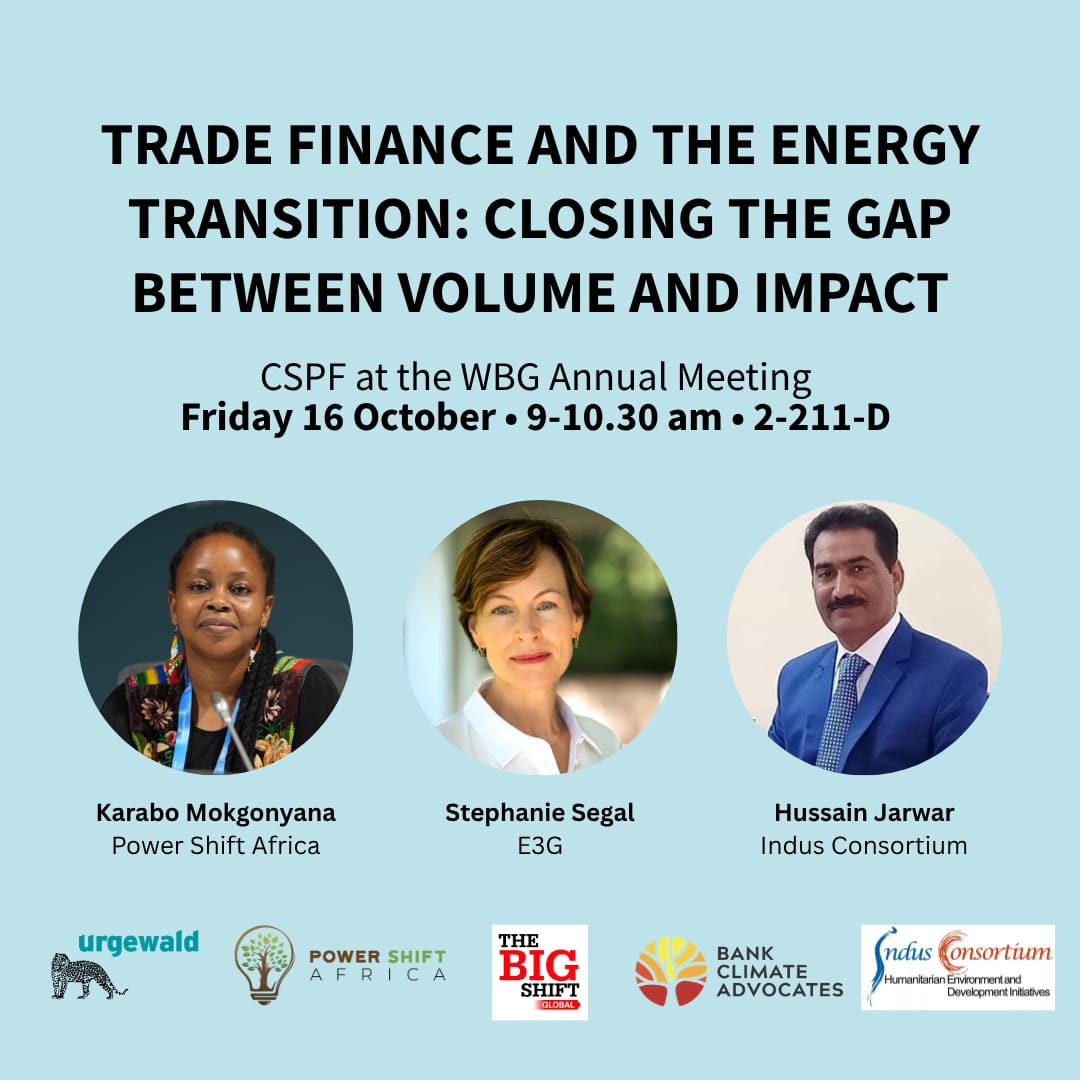
Co-organized by Urgewald, Power Shift Africa, The Big Shift, Bank Climate Advocates, and Indus Consortium, this session aims to discuss projects where trade finance is used to fund fossil fuel trade.
Speakers include Karabo Mokgonyana (Power Shift Africa), Stephanie Segal (E3G), and Hussain Jarwar (Indus Consortium).
October 16 | 1:00 PM – 3:00 PM
Gallery Room, 3rd Floor, Bangkok Art & Culture Centre
Broken Promises: Decades of Advocacy Amidst Continue World Bank Financing for Dam Projects
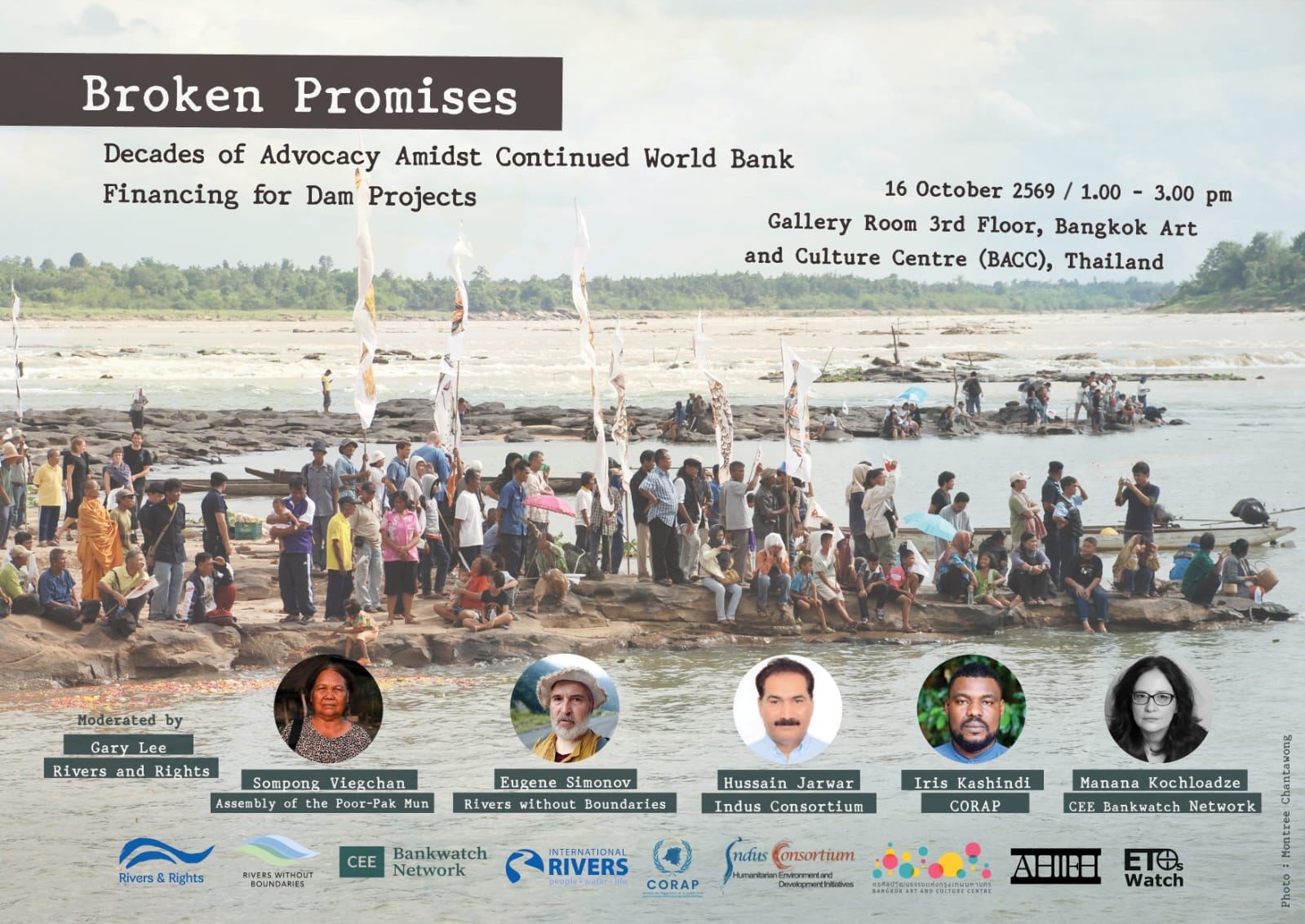
This session will focus on hydro financing and it’s impacts on communities, environment and just energy transition. Experiences of communities and CSO perspective and testimonies will shared.
Speakers include Gary Lee (Rivers and Rights, Moderator), Sompong Viegchan (Assembly of the Poor-Pak Mun), Eugene Simonov (Rivers without Boundaries), Hussain Jarwar (Indus Consortium), Iris Kashindi (CORAP), and Manana Kochloadze (CEE Bankwatch Network).
Access the full People’s Assembly schedule.
Access the full CSPF schedule.