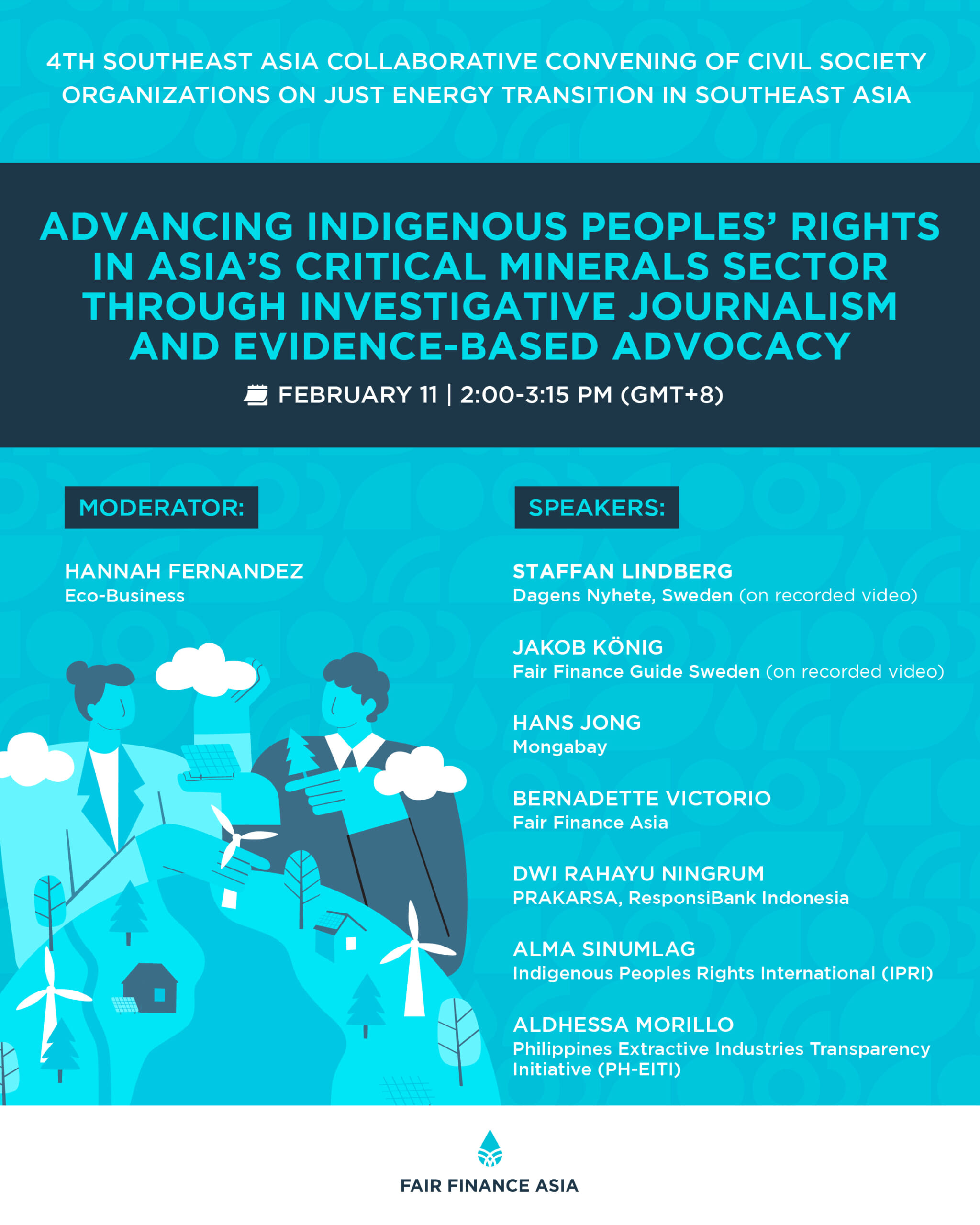
On February 11, Fair Finance Asia (FFA) will conduct a critical minerals session, “Advancing Indigenous Peoples’ Rights in Asia’s Critical Minerals Sector through Investigative Journalism and Evidence-based Advocacy,” at the 4th Southeast Asia Collaborative Convening of Civil Society Organizations (CSOs) on Just Energy Transition (JET) co-organized by FFA, Oxfam’s Influencing Just Energy Transition Program, and the Asia Network for People’s Energy (ANPE) in Manila, Philippines.
FFA’s session aims to highlight the critical role played by CSOs and journalists in amplifying the voices of Indigenous Peoples and local communities affected by cross-border critical minerals investments through joint investigative reporting and evidence-based advocacy. The session will facilitate a discussion on how civil society expertise and media reporting can help inform financing decisions and regulatory frameworks through inclusive engagement, public dialogue, and highlighting the need for a more transparent approach to financial and corporate governance to combat corruption and shrinking civic space in Asia.
Background:
FFA’s 2024 report Unearthing the hidden costs: Social and environmental considerations in Asia’s transition minerals mining and supply chains, revealed that banks based in Japan and the Association of Southeast Asian Nations (ASEAN) are financing United States (US), European, and Asian downstream electric vehicle (EV) manufacturers who have indirect supply chain links to three nickel mining sites in Indonesia and the Philippines.
This report laid the groundwork for a series of hard-hitting investigative articles on PT Weda Bay Nickel mine Indonesia by Sweden’s largest morning newspaper, Dagens Nyheter (DN), in collaboration with Fair Finance Guide Sweden (FFGS) (English translations here). Published in September and October 2025, the series revealed that Swedish banks were using “green” funds to finance the mine. The mine, a part of Asia’s critical minerals value chains, continues to be linked with serious human rights and environmental rights impacts, especially on affected Indigenous Peoples and local communities, such as displacement from ancestral lands and threats to their livelihood, culture, and way of life. Since the investigation was published, four Swedish banks have now divested from the mine. Two other banks have increased their engagement with the company to address the issues. The investigation also found that multinational Swedish car manufacturing company, Volvo Group, is possibly sourcing nickel from the mine.
Session Objectives:
- Demonstrate the importance of synergies between investigative journalists and civil society in amplifying the voices of IPs and local communities affected by cross-border critical minerals investments in Asia and holding banks, companies, and other duty-bearers accountable.
- Facilitate a multi-stakeholder discussion on strengthening accountable governance for financial institutions, regulators, and key duty-bearers in Asia’s critical minerals supply chains through investigative journalism and evidence-based advocacy that promotes transparency and public dialogue.
Speakers:
- Staffan Lindberg, Investigative reporter, Dagens Nyheter, Sweden (on recorded video)
- Jakob König, Lead, Fair Finance Guide Sweden (on recorded video)
- Hans Jong, Environmental Journalist and Staff Writer, Mongabay
- Bernadette Victorio, Program Lead, Fair Finance Asia
- Dwi Rahayu Ningrum, Sustainable Development Officer, PRAKARSA, ResponsiBank Indonesia
- Alma Sinumlag, Focal Point Business and Human Rights, Indigenous Peoples Rights International (IPRI)
- Aldhessa Morillo, Economic Development Specialist, Philippines Extractive Industries Transparency Initiative (PH-EITI)
- Hannah Fernandez, Chief Correspondent, Philippines, Eco-Business (moderator)
More information:
- Read Dagens Nyheter and Fair Finance Guide Sweden’s investigation series on PT Weda Bay Nickel Mine here.
- Read FFA’s 2024 report on critical minerals supply chains here.
- View FFA and Think Policy Society (TPS) video explainer on Asia’s just energy transition here.